








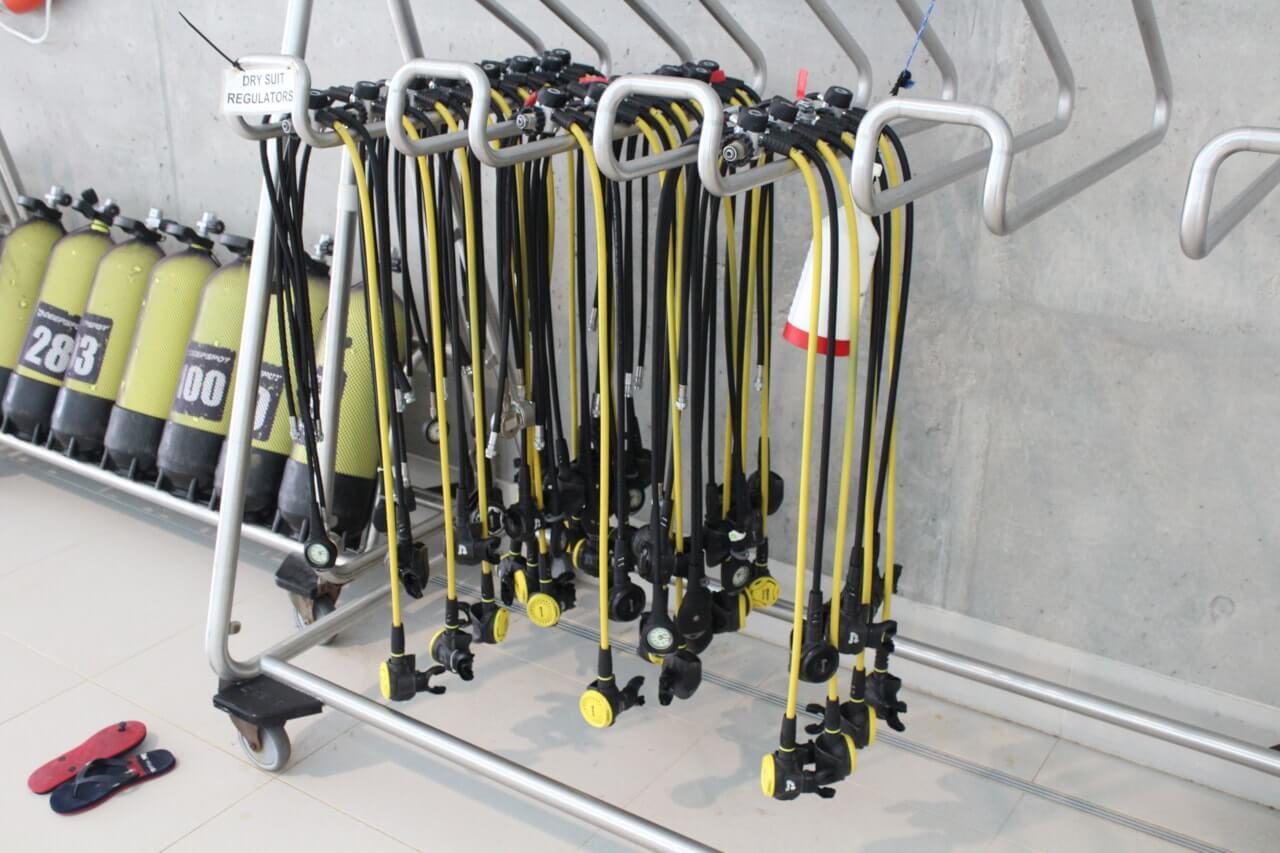
Finally, after discussing regulator types and their servicing, let’s describe the different types of alternative gas sources underwater (as an exceptionally precise diver would say) or octopuses, to use the slang term.
Octopus
Generally, a typical octopus is exactly what it looks like. It is simply an additional second stage connected to the same first stage (photo: Typical regulators with octopuses – first photo in the article).
It has many advantages: it is easy to install, inexpensive (only an additional second stage), easy to operate, and widely used, so everyone knows how to handle it.
The advantages of the octopus are its simplicity, low cost, ease of placement on the equipment, and a certain level of standardisation – most divers know how to use it.
The disadvantages of the octopus become apparent when, for some reason, you need to swim horizontally for a longer period after a failure. The relatively short octopus hose requires close and good cooperation between both divers. It is easier if you can ascend immediately.
Spare air source on the inflator
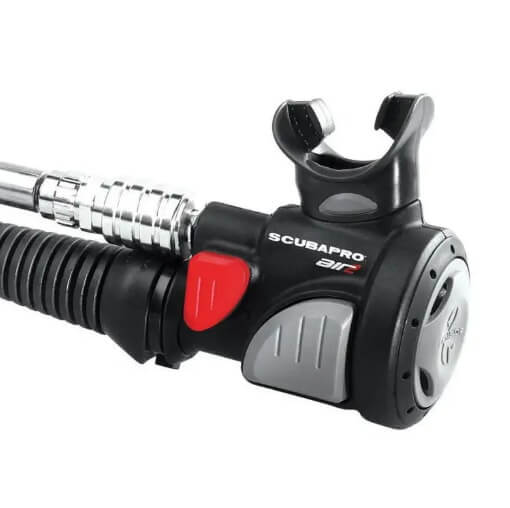
A spare regulator integrated with the inflator (photo: Air II) can also be used for air sharing. However, the inflator hose is short enough that the donor switches to breathing from their integrated inflator, giving their primary regulator to the diver without air. Some divers use their primary regulator on long hoses, which provides greater air-sharing capabilities. The advantage of this solution is its simplicity. We have less equipment – it is lighter. The disadvantage is a certain lack of standardisation and the fact that we must give away the regulator we are breathing from to our partner and switch to the second stage on the BCD inflator ourselves.
Spare Air
When we want to combine self-sufficiency but don’t have access to a system with a second cylinder – for example, because we are on a typical diving trip with typical recreational gear but can’t or don’t want to rely on a buddy (underwater photographer, guide, etc.) – an interesting solution is a small independent cylinder with a regulator (photo: Spare Air). Such a bottle with its own regulator on top of the cylinder valve allows for only a dozen or so breaths, but it is enough for an efficient emergency ascent. We are independent of the group and partners. In certain situations, this can be useful. If you are an underwater photographer, you might consider such a solution.
Additional, second regulator – separate 2nd stage
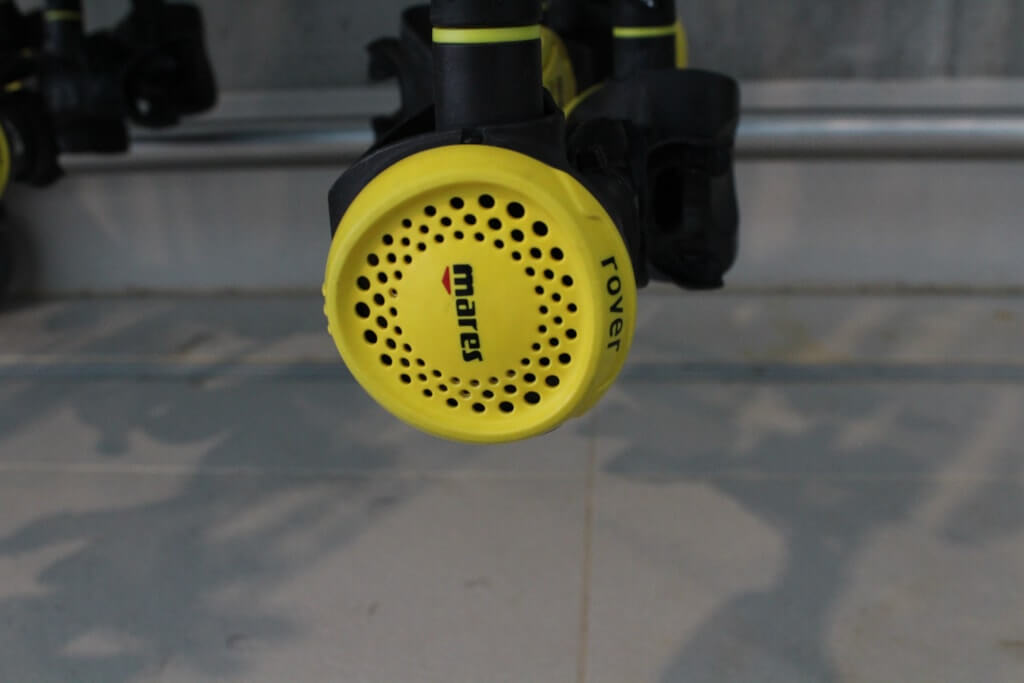
In configurations adapted for diving in situations where greater self-sufficiency is needed to handle emergencies, we use more complex setups than the one with an octopus. Such configurations are standard for divers who, due to the type of diving they do, use sidemount or twins (Separate 2nd stages in a sidemount configuration).
When a diver needs to be self-sufficient, they must have their own separately supplied alternative gas source – not an octopus, which is connected to the same cylinder, but a separate second regulator. A separate 1st and 2nd stage, a pressure gauge, and often a hose to power a second buoyancy source, e.g., a second bladder in a wing. Often the second regulator – the one intended to be handed over – is on a long hose, sometimes even 2 metres long. This allows divers to swim one behind the other in the event of a failure. In such a case, the receiver swims in front.
Two cylinders and two regulators
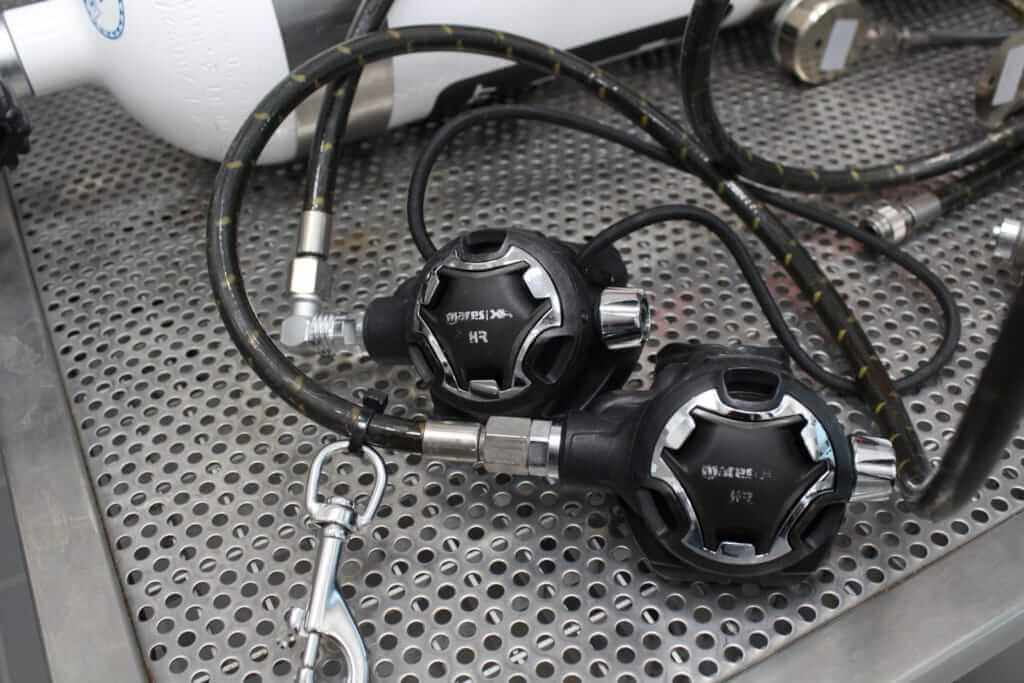
While you might see someone using two separate regulators on a double valve on a single cylinder, it is a rather rarely used solution. It is slightly safer than a single regulator with an octopus, but definitely not as good as two cylinders with two regulators. Such completely separate air sources – i.e., two cylinders, each with its own regulator, whether in the form of a twinset or two sidemount cylinders – are recommended especially in very cold water, where the risk of the regulator freezing and gas escaping from the cylinder is quite high.
The two typical solutions are Twin and sidemount.
Twin
Twin is a slang term for two cylinders worn on the back, connected by a manifold with an isolator. This type of valve allows for the connection of two independent regulators, but at the same time, in the event of one regulator failing, after closing the valve on that regulator, gas can still be drawn from both cylinders through the second regulator. Additionally, the isolation valve on the manifold allows both cylinders to be efficiently separated in the event of a regulator failure and gas escape – it only escapes from one cylinder. However, this solution has a certain drawback – although it concerns an extremely unlikely failure. In the event of a manifold failure, one could imagine losing gas from both cylinders. A solution with two cylinders without a connection – the so-called independent doubles – does not have this drawback.
A solution that uses two completely separate cylinders is sidemount.
Sidemount
Sidemount is a system created for cave diving to enable squeezing through narrow restrictions. The system consists of two cylinders mounted at the diver’s sides, which can be easily detached. Each cylinder has its own regulator with a pressure gauge. One regulator (on the left cylinder) has a short hose; the second regulator (on the right cylinder) has a 2nd stage on a long hose to allow swimming with a partner in a single-file formation. Since the cylinders do not have a manifold, the diver must regularly swap regulators to consume air from both cylinders relatively evenly. Sidemount also has the advantage over a twinset of very easy access to the valves. It is much easier to turn off a valve in the event of a failure (free-flow/freezing) of one of the regulators.
With both the twinset and the sidemount system, when a diver’s partner needs air, the donor gives them the 2nd stage taken from their mouth on the long hose and switches to the second 2nd stage hanging around their neck on a short hose.