








Diving tips help you organise your equipment, reduce stress and focus on what’s happening underwater. However, they’re no substitute for training, safety procedures or a buddy check. The best diving tip is a simple technique you know from training, can use without rushing and that doesn’t get in your buddy’s way.
Start with your own preparation routine
Before a dive, it’s easy to get distracted by a conversation, a change of plan or a search for a small piece of equipment. That’s why you should always prepare your equipment in the same order. You could work from your cylinder and regulator through to your buoyancy device, then your mask, fins and accessories. A consistent routine makes it easier to spot anything missing or a piece of equipment you haven’t checked yet.
A short checklist on your phone or in a notebook can help. Divide it into three sections:
- personal belongings and documents,
- equipment used during the dive,
- things you’ll need after getting out of the water.
Keep accessories in their usual places. If your spare mask, buoy or slate always goes in the same pocket, you won’t have to search for it by feel. Your configuration should match your training, the diving conditions and what you’ve agreed with your buddy.
How can you reduce mask fogging?
A foggy mask makes it harder to see your surroundings and communicate. Before using it for the first time, prepare it according to the manufacturer’s instructions, as the method may depend on the type of lens and its coating. Before entering the water, apply an anti-fog product designed for masks, spread it over the inside and rinse as directed.
Once you’ve prepared your mask, don’t touch the inside with your fingers. Greasy marks can reduce the effectiveness of the product. It’s also worth learning to flood and clear your mask calmly underwater. That way, temporary fogging or water getting inside doesn’t have to mean ending the dive straight away. Practise this skill in controlled conditions and within the limits of your certification.
Organised equipment means fewer unnecessary movements
A loosely dangling pressure gauge, torch or hose can snag on your surroundings and make it harder to maintain a comfortable position. Secure accessories so they remain accessible without sticking out from your body. Every clip should have a specific purpose, and you should practise using it with gloves on too, if you plan to wear them.
There’s no need to take every gadget underwater at once. Introduce new equipment one item at a time and first try it during an easy, familiar session. This will show you whether you can reach, unclip and reattach it without losing control of your position. After diving, put small parts in one container, ideally a ventilated one. Rinse and dry your equipment according to the manufacturer’s instructions. Note any faults immediately after the session to reduce the risk of only remembering them during your next preparation.
Buoyancy and trim instead of fighting your equipment
There’s no single weighting setup that works for everyone and every configuration. The amount of weight you need depends on your equipment, the type of suit and the conditions, among other factors. Make changes gradually, ideally under an instructor’s supervision, and assess the result in a safe, controlled environment.
Good trim reduces the need to constantly use your fins and hands to maintain or adjust your position. Before moving your weights, check the position of your cylinder, buoyancy device and accessories. Sometimes the problem isn’t the amount of weight, but its distribution or the tension in parts of your configuration.
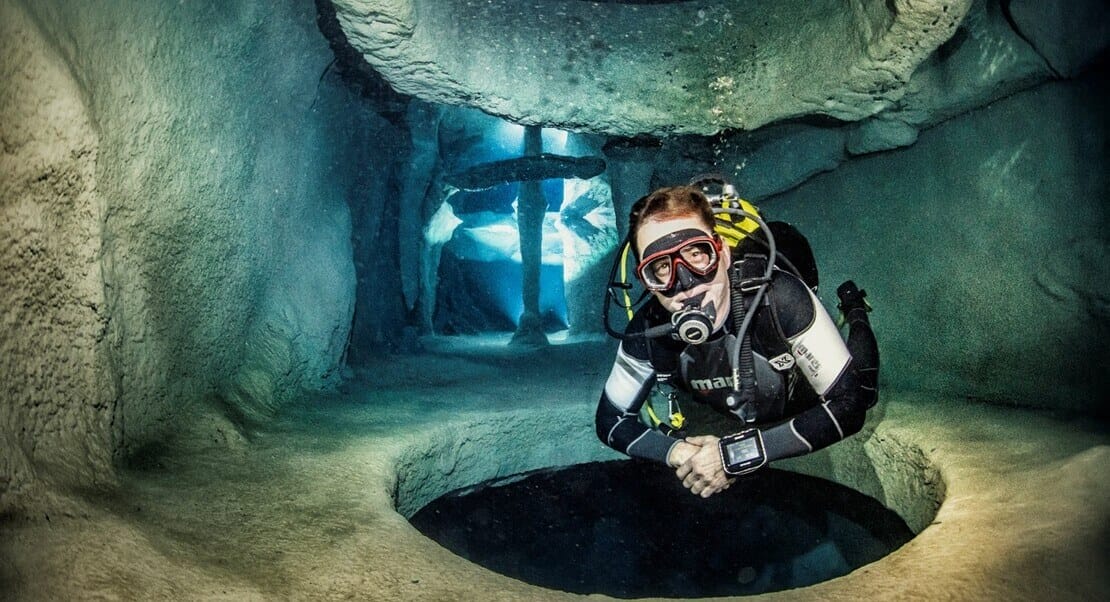
A video filmed from the side is useful for practice. It lets you see the position of your legs, head and torso, which you may not always be aware of underwater. At Deepspot, you can train in clear water at 32 °C, in a 45.4 m-deep pool with underwater caves, a wreck and a tunnel. Always choose a training depth that suits your qualifications and session plan.
Agree on communication before entering the water
Standard signals are the foundation of underwater communication, but before descending, it’s also worth discussing the plan, swimming order, what to do if you lose contact and the signal for ending the dive. If you use a torch, agree on how to signal with the light. In poorer visibility, your buddy should know where to look for your signal.
For a more complex task, you can take a writing slate. Note the most important values or the steps in your plan rather than relying solely on memory. Don’t put too much information on it, though – your notes need to be legible and easy to check without taking your attention away from your surroundings for too long.
Choose techniques that suit the type of diving
What works for recreational scuba diving may not suit other disciplines. If you’re still learning the basics, an OWD diving course could be your next step. It prepares you to plan and carry out recreational dives with a buddy within the limits of your certification. In freediving, the priorities are proper technique, relaxation and appropriate buddy support. Do not hyperventilate or attempt to break records on your own. Practise according to the principles learned in training and with a suitably trained buddy.
Technical diving, on the other hand, requires appropriate training, planning and a configuration suited to the specific dive. Don’t copy setups you’ve seen experienced divers use without understanding how they work. First establish what problem a piece of equipment solves and whether you can use it in an emergency.
Summary
Good diving tips make it easier to prepare for a dive, keep your equipment organised and improve your comfort underwater. It’s worth developing your own preparation routine, keeping your configuration organised, and paying attention to proper buoyancy and communication with your buddy. Remember that every technique should suit the type of diving, your equipment and your qualifications. Test new accessories and configuration changes gradually, ideally under an instructor’s supervision. Most importantly, the tips you use should improve comfort and safety, not replace knowledge, skills and established procedures.
FAQ
Should you copy your instructor’s equipment configuration?
You can use it for inspiration, but not as a ready-made template. Your configuration depends on the type of diving, your equipment, body shape and training. Discuss every change with an instructor and test it in controlled conditions.
What should you include in a spare parts kit?
Choose the contents to suit your equipment and its manufacturers’ recommendations. Useful items include parts you know how to replace correctly without working on components that require servicing. Having spares isn’t enough – you also need to know when to cancel a dive and take your equipment to a specialist.
How can you remember your setup from a successful session?
Keep a short log. Record your configuration, weight distribution, the equipment you used, the conditions and your own observations. Before your next dive, you can refer to those details instead of trying to recreate your setup from memory.